- Author
- Sharam Kohan
- Year
- 2026
- Pages
- 212
- ISBN
- 979-8-234-11421-1
- Format
- Paperback
- Price
- $24.99
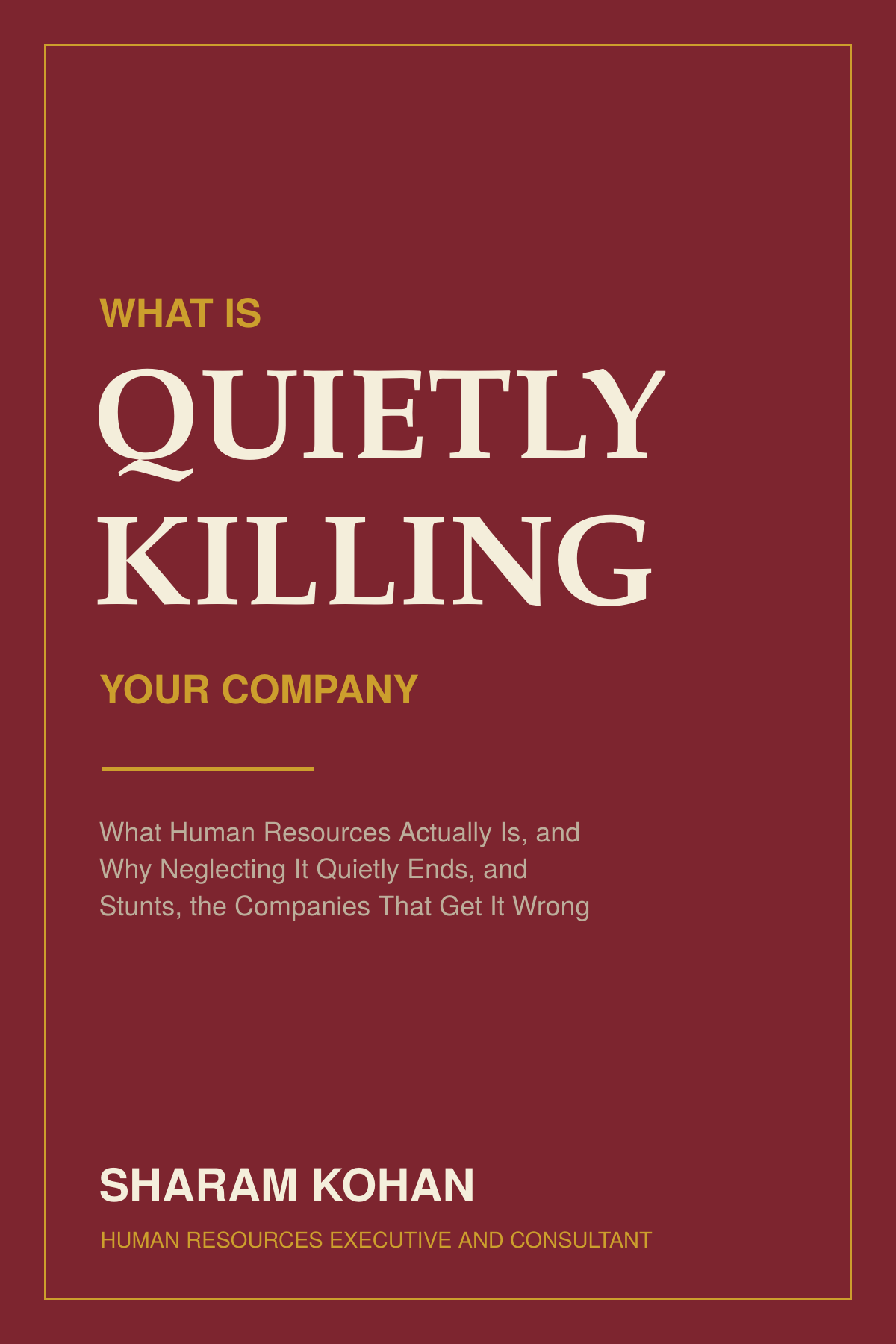
What Is Quietly Killing Your Company
What Human Resources Actually Is, and Why Neglecting It Quietly Ends, and Stunts, the Companies That Get It Wrong
Core Argument
Companies are supposed to die dramatically, from a disruptive rival, a failed product, or a scandal with a date attached. Most do not. They decline quietly, from the inside, from a cause their own instruments are built not to see, or they quietly stop short of the company they could have become, leaving no trace on any ledger.
The book makes an evidence-based case that the most expensive failures in business trace to a single, chronically misunderstood function: the management of people. Most organizations treat human resources as overhead, a department to be kept lean and kept away from the decisions that matter, and then blame the market when their best people leave, their strategies fail in execution, and their culture quietly erodes.
Drawing on behavioral economics, organizational psychology, and the documented histories of companies that rose and fell on how they managed their people, from Nokia and Boeing to Wells Fargo and Costco, the book shows that human resources, rightly understood, is not the picnic-and-benefits department but the strategic stewardship of the one asset that decides whether a company thrives, scales, or quietly fails.
What Makes This Book Different
This is not a book of slogans. It puts a price on the costs no financial statement records: the regretted departure, the bad hire, the disengaged team, the succession that was never planned. It explains why managers account for most of the variation in engagement, why culture reaches the balance sheet, and why the chief executive is so often the barrier to the very outcomes he wants. And it makes its case in the only language the boardroom cannot wave away: money, risk, and return. For executives, managers, and the human resources professionals who serve them, it is a field guide to the part of the company most leaders have been managing blind, and a clear account of what it has been costing them.
Who This Book Is For
Chapter-by-Chapter Overview
Part One · The Misdiagnosis
Establishes the two forms of quiet loss: the company that erodes from the inside and the company that quietly stops short of what it could have become. Explains why the dramatic death crowds both out of the executive imagination.
Defines the function's two layers, the visible administration and the strategic stewardship beneath it, and states the claim on which the book rests.
Traces the function's history from welfare and administration through the Hawthorne studies and the personnel era to the modern strategic-partner model, and explains why the old understanding persists.
Examines why the prejudice against the function is not stupid, how it perpetuates itself, what the prejudice costs, and what it takes to break the loop.
Part Two · The Case
Advantage built through people is valuable, rare, hard to imitate, and cannot be bought. States the evidence honestly and puts the test to the reader's own company.
Puts a price on the regretted departure, the bad hire, and the disengaged team, and explains why none of it appears on any statement an executive reads.
Managers account for most of the variation in team engagement. Examines the chronic underinvestment in the role, what the role actually requires, and the function's lever.
What culture actually is, how it forms, how it drives or erodes performance, and how to read the culture you actually have rather than the one on the poster.
Discretionary effort, psychological safety, and fairness as strategy rather than only compliance. Identifies the signs that the margin is being withheld.
The categories of consequence when the function is neglected, the attribution trap that conceals them, and how a leadership team escapes it.
Part Three · The Evidence
Why measurement is the crux of the function's credibility, the three levels of people analytics, the boundary of what can honestly be measured, and a discipline for honest claims.
The handful of measures, turnover and retention among them, that reliably carry information about the human condition of a company before the financial statements move.
How the function earns its hearing by translating people outcomes into the only language the boardroom cannot wave away.
Part Four · The Craft
The capabilities the function requires, and why staffing it with administrators guarantees an administrative function.
Hiring as the most consequential and least disciplined decision process in most companies, and what a disciplined process looks like.
Replacing ritual evaluation with management that actually improves the performance it measures.
Compensation as the company's most legible statement of what it actually values, and how to design it deliberately.
Planning for the people the strategy requires before the strategy requires them.
Handling conflict, complaint, and separation before they become litigation and liability.
Part Five · The Executive's Part
Why the chief executive is so often the obstacle to the very outcomes he wants, and what it costs him to remain so.
The people-feasibility of a strategy is a load-bearing question. The head of the people function is the instrument a chief executive otherwise flies without.
What the right leader of the function actually contributes: predicting the human outcomes of strategic choices, diagnosing the people-related causes of problems, and prescribing the actions that create value.
Why the function's value is greatest before the strategy is set, not after it has failed in execution.
What automation and the changing workforce will demand of the function, and of the executive who leads it.
Part Six · The Whole
Brings the argument together: human resources as the strategic stewardship of the one asset that decides whether a company thrives, scales, or quietly fails.
What each must now do differently, stated plainly and without slogans.
Available on Amazon
What Is Quietly Killing Your Company is available in paperback on Amazon.