Human Resources · Organizational Strategy · 2026

Most companies do not die from a bang. They die from a whisper, from a cause their own instruments are built not to see.
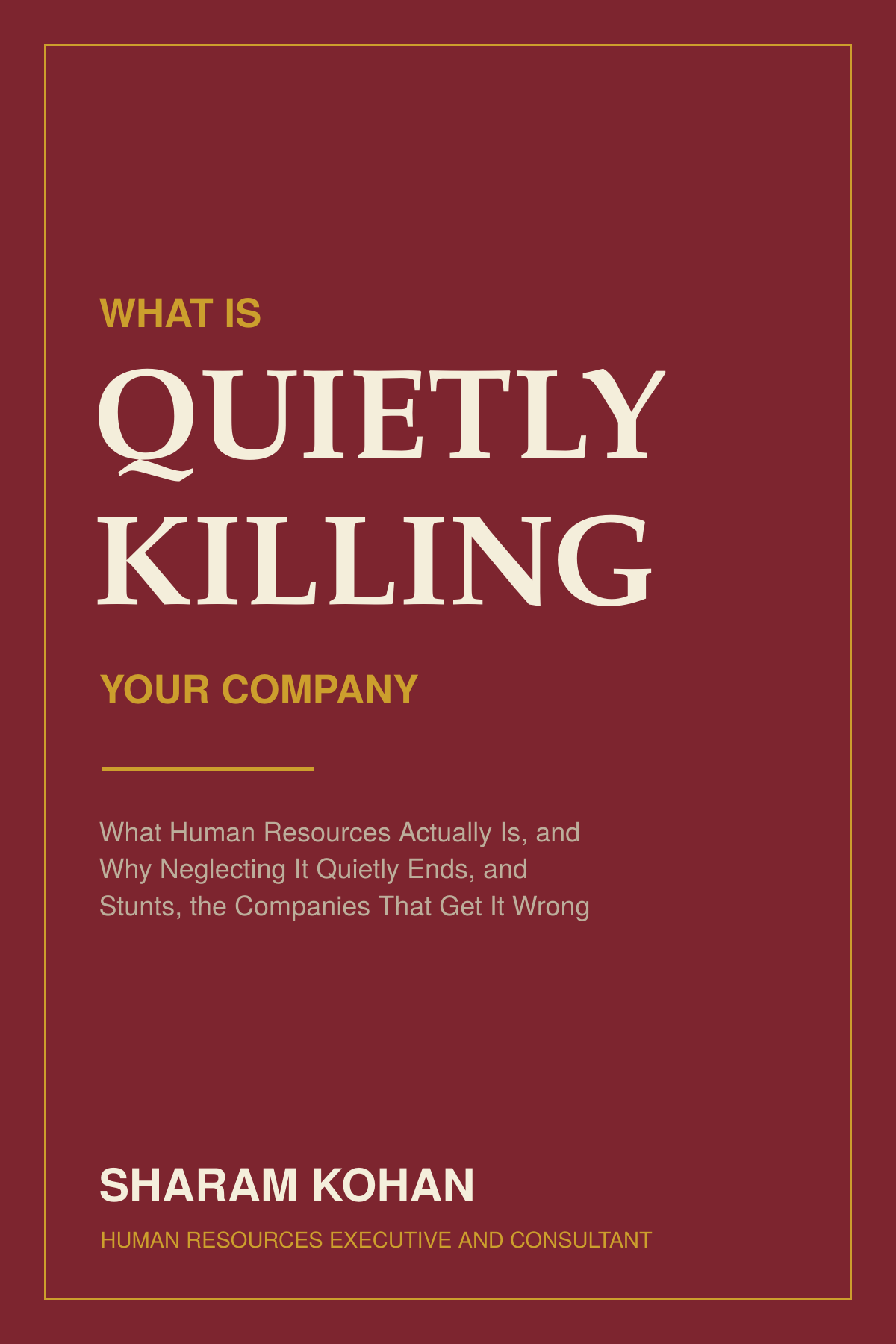
What Is Quietly Killing Your Company by Sharam Kohan

What this book is about

You have watched the best people leave for polite reasons, watched strategies that looked sound on the whiteboard fail in execution, and watched the culture sour by degrees no one can date. You do not need another book of slogans. You need to understand what is actually being lost, and where.

What Is Quietly Killing Your Company makes an evidence-based case that the most expensive failures in business trace to a single, chronically misunderstood function: the management of people. Most organizations treat human resources as overhead, a department to be kept lean and kept away from the decisions that matter, and then blame the market when the decline arrives. This book puts a price on the costs no financial statement records, and shows what the function, rightly understood, must become.

About the Book
26
Chapters across six parts, from misdiagnosis to remedy
212
Pages of evidence, case history, and practical prescription

Who this book is written for

Chief Executives & Founders
Who suspect the ceiling on their company's growth is internal and want a rigorous account of where it sits.
CFOs, COOs & General Managers
Who need the people case made in the only language the boardroom cannot wave away: money, risk, and return.
Senior HR Leaders & CHROs
Who need the strategic case for their own function stated at boardroom strength, with the evidence honestly weighed.
Line Managers & Rising Executives
Who carry most of the variation in team engagement and have rarely been told so, or shown what the role actually requires.
Board Members & Investors
Who must judge whether a management team can scale before the lagging indicators reveal that it cannot.
Management Consultants & Advisors
Who need a disciplined account of the people-side costs and levers their client engagements keep encountering.
Business School Faculty & MBA Programs
Seeking a practitioner-grounded text that bridges the research evidence and applied management practice.
Anyone Who Has Watched a Good Company Stall
Despite real effort, and who needs a rigorous explanation, not reassurance.

What you will find inside

Why the most common corporate death is quiet, and why the autopsy looks in the wrong place. Defines what human resources actually is, traces how business got the wrong picture, and dismantles the picnic-and-benefits prejudice.
The strategic case for the function: the costs no statement records, the manager multiplier, culture as an asset, trust and discretionary effort, and the full price of getting it wrong.
The measurement problem, the metrics that actually carry information, and how to speak the language of the C-suite.
Staffing the function itself, hiring for the long term, performance management that develops, compensation as signal and strategy, workforce and succession planning, and handling disputes.
The barrier at the top, giving the function its standing, choosing a strategist over an administrator, and using the function before the decision hardens.
The function and the enterprise brought together, and a closing word to the executive, the manager, and the profession.
Full Chapter Overview

The argument in four claims

01
The Quiet Decline
Most companies do not die dramatically. They decline from the inside, or quietly stop short of the company they could have become, and no statement records the distance between what a company is and what it had the capacity to be.
02
The Costs No Statement Records
The regretted departure, the bad hire, the disengaged team, the succession that was never planned. The most expensive failures in business appear on no statement an executive reads, and what is never counted is never managed.
03
The Manager Multiplier
Managers account for most of the variation in team engagement. The selection and development of managers is the highest-leverage people investment a company can make, and the one most companies systematically underfund.
04
The Barrier at the Top
The chief executive is so often the barrier to the very outcomes he wants. Until the function is given its standing, staffed with a strategist, and used before decisions harden, nothing else in the book will hold.
Explore the Key Ideas
Sharam Kohan, author of What Is Quietly Killing Your Company

Sharam Kohan

Sharam Kohan has spent more than twenty-five years in senior management and executive human resources roles across the healthcare, technology, energy, hospitality, retail, and nonprofit sectors. He has long held that human resources, rightly understood, is not the administrative department it is taken to be but the strategic stewardship of the asset on which a company's success most depends.

An alumnus of Harvard University, he earned an LL.M. from the University of California, Berkeley, School of Law, and completed graduate legal coursework at Temple University School of Law with a focus on employment law and employment discrimination. A SHRM-certified human resources professional, he advises organizations through his own consultancy and is the author of The Honest Organization.

Full Biography

Receive a free chapter excerpt

Subscribe to receive new essays on the management of people and the strategic role of the function.

What Is Quietly Killing Your Company

What Is Quietly Killing Your Company

Available in paperback on Amazon. Published 2026. ISBN 979-8-234-11421-1. $24.99.

Order on Amazon